
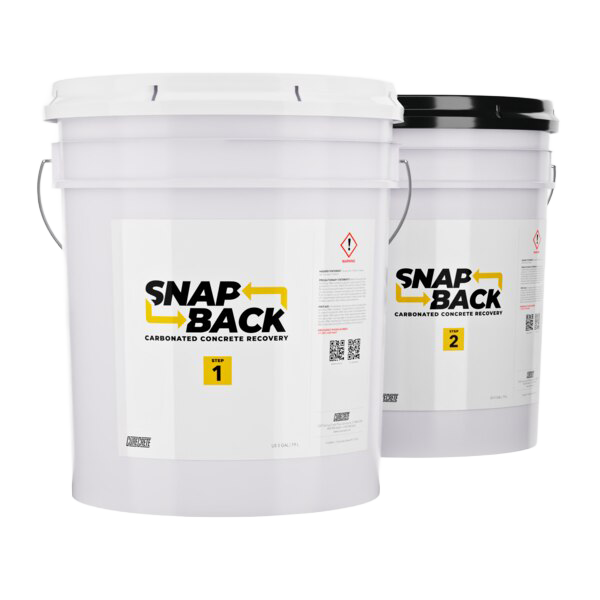


SnapBack restores soft, carbonated concrete to a hardened, functional surface, without slab replacement or extensive grinding. Carbonation leaves floors chalky and prone to dusting, often from running fuel-powered equipment indoors during winter construction. SnapBack’s two-step treatment hardens the surface in place, with no separate densifier required. In testing, treated cores went from Mohs 3 to Mohs 7.5, at up to 90% less cost than replacing the slab.
SnapBack
Carbonated Concrete Recovery
Sizes:
110 gal Kit, 10 gal Kit
Coverage Rates:
Part 1: 160–200 ft²/gal Part 2: 200 ft²/gal
Dilution Ratio:
Ready to Use
Quick Links & Tools
Hardens the Slab in Place
Restores surface hardness on the existing slab and delivers the same durable results expected from traditional OPC concrete.
No Densifier Needed
The two-step treatment is a complete solution on its own, so there's no separate densifier to buy or apply.
Avoids Slab Replacement
Saves the slab instead of tearing it out, reducing costs by up to 90% compared with total replacement.
Skips Extensive Grinding and Overlays
Recovers the surface without labor-intensive grinding or overlays, which saves crew time and equipment wear.
Keeps Projects on Schedule
Treatment takes two flood coats with one-hour dwell times, followed by five days of routine cleaning. That avoids the long downtime of replacement or heavy grinding.
A More Sustainable Fix
Keeping the existing slab avoids demolition, disposal, and new concrete. Both steps also contain no VOCs.
For full application instructions, view the Technical Data Sheet (TDS).
How do I know if my floor is carbonated?
Common signs include a dull, faded surface, a soft or powdery texture, dusting or crumbling, and quick water absorption. The only definitive test is to pull a core sample and apply phenolphthalein. Carbonated areas show a color change because carbonation lowers the concrete’s alkalinity.
What causes concrete to carbonate?
It’s most often caused by running fuel-powered equipment, like heaters or forklifts, indoors without proper ventilation. That’s why it tends to be a seasonal problem, showing up after winter construction in colder climates.
What if the carbonation is severe?
Start with a Mohs scratch test in several locations to establish a baseline and gauge how deep the damage goes. In severe cases, some stock removal may be needed before applying SnapBack, but it’s still far less than the extensive grinding or full replacement it avoids.
What’s the difference between SnapBack and PowerPrep LC?
PowerPrep LC is a pre-treatment for new low-carbon slabs that are gaining strength slowly, and it must be paired with Ashford Formula or RetroPlate. SnapBack is for surfaces that have already been damaged by carbonation, and it restores hardness on its own without a densifier.
Is carbonation only a problem with low-carbon concrete?
No. Carbonation can affect any concrete, including traditional OPC. Low-carbon mixes like Type 1L may have a higher tendency to carbonate, so ventilation and equipment choices during construction matter even more on those projects. SnapBack restores carbonated surfaces on both.
Coverage Calculator
Calculate Your Product Needs
Coverage Rates: 1,500–2,000 ft2/gal (37–50 m2/L)
RetroGuard
Coverage estimate based on the selected area and RetroGuard coverage rate.
Estimated
0 gal
Based on 1,500–2,000 ft²/gal
Find a Curecrete Expert Near You

PLEASE FILL IN THE FORM BELOW
Finding your local expert
Connecting your location with our representative network.
Try These Picks


Get In Touch
Need pricing or more details? We’re ready to support your project and answer any questions you may have. Let’s keep the conversation going!